






The Buddha was a historical person, born as Prince Siddhartha in India in the 6th century BC. He was not a god, nor an incarnation of any divine being, but a human being who attained supreme wisdom and enlightenment through his own insight and effort.
He lived a life that confronted the realities of human existence aging, sickness, and death symbolized in the four sights that changed his destiny: an old man, a sick person, a corpse, and a serene monk. These experiences awakened his deep understanding of Dukkha, the dissatisfying nature of life.
At the age of 29, Prince Siddhartha renounced his royal comforts in search of the truth. He practiced asceticism and realized that neither indulgence nor self-torture could bring peace. Thus, he discovered the Middle Path, a way of balance and mindfulness.
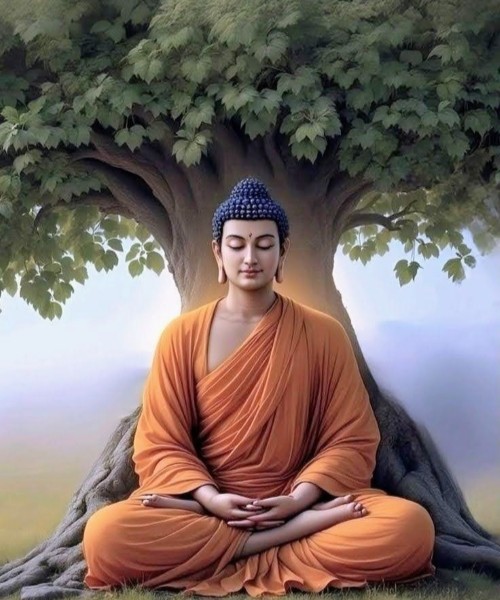
Seated under the sacred Pipal tree (Ficus religiosa) on the bank of the river Neranjana, he attained Enlightenment at the age of 35, becoming The Buddha “The Awakened One.”
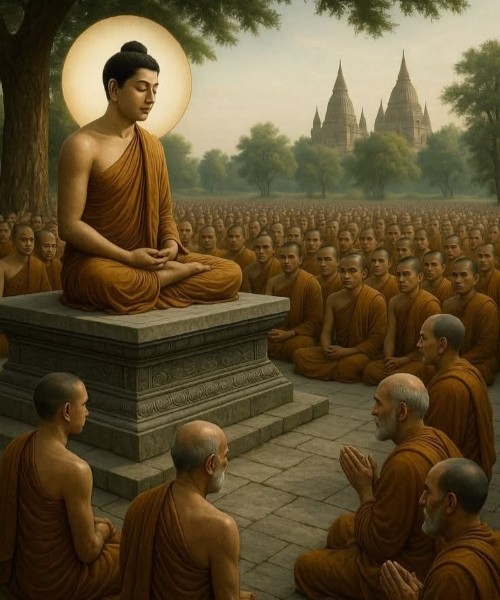
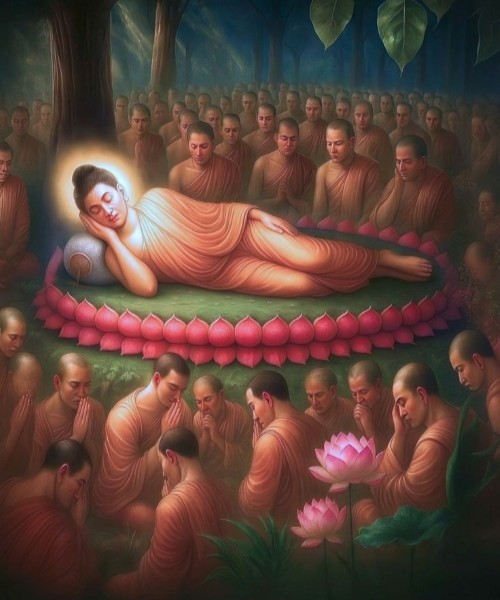
For 45 years, he shared his insights across Northern India, teaching all without distinction of caste or class. At the age of 80, he passed away peacefully at Kusinara (modern Uttar Pradesh), attaining Parinibbana the final liberation.
The Buddha never claimed to be divine. He said,
“The Tathagata (one who realizes the truth) is only a teacher.”
He emphasized that each person must observe and practice to gain freedom. His greatness lies in this the recognition of human intelligence and conduct as the path to liberation.
For over 2,272 years, (to the year 2025) Buddhism has been the guiding force behind Sri Lankan culture and spiritual life. Though many see it as a religion, the Buddha’s Dhamma is not about worshipping a creator or controller. It is a practical path to spiritual awakening, based on understanding, compassion, and mindfulness.
Theravada Buddhism emphasizes that for a person to be truly perfect, two essential qualities must develop equally:


If compassion is developed without wisdom, one becomes a kind-hearted fool. If wisdom is developed without compassion, one becomes a cold intellect. Therefore, the balance between heart and mind is essential. This harmony forms the objective of the Buddhist way of life, where wisdom and compassion are inseparable.
The essence of Theravada Buddhism is beautifully expressed in the Buddha’s first sermon, the Dhammacakkappavattana Sutta the “Setting in Motion of the Wheel of Truth.” In it, the Buddha explained the Four Noble Truths, which form the foundation of the entire Dhamma:
The Four Noble Truths are not beliefs to be accepted blindly but realities to be realized and experienced through one’s own effort.
The Buddha’s teachings are summarized in three primary concepts, forming the foundation of the path to enlightenment
Sila is considered the ethical foundation of Buddhism because it focuses on cultivating wholesome thoughts, speech, and actions. It guides a person to live in harmony with truth, kindness, and compassion. In Buddhist teaching, virtuous conduct is not something to be displayed outwardly or practiced merely for praise. Instead, it must arise from a genuinely pure and disciplined mind. The Buddha emphasized that one should not pretend to be good; true goodness comes from sincere intention and inner clarity. Therefore, morality in Buddhism is rooted in the transformation of the mind rather than external appearance or ritual behavior. This inner discipline cannot be forced by rules or imposed by any authority. It grows naturally through personal understanding, awareness, and consistent self-reflection. When individuals develop Sila in this way, their actions become peaceful, their speech becomes truthful, and their way of life becomes beneficial to themselves and others.
Samadhi refers to the deep mental focus and calmness that arise through disciplined meditation practice. In Buddhism, it is understood as the state in which the mind becomes steady, clear, and fully collected, without being pulled in different directions by distraction or restlessness. When a person develops Samadhi, their thoughts no longer wander aimlessly, and their emotions become balanced and peaceful. This concentrated state allows the mind to settle into stillness, creating the conditions for genuine inner serenity. Through continuous practice, one gains mastery over mental activity, learning how to observe thoughts without being controlled by them. As the mind becomes more refined and stable, deeper levels of insight naturally emerge. Samadhi therefore serves as a powerful foundation for understanding the true nature of reality. It not only brings calm and clarity but also supports wisdom, compassion, and overall spiritual growth on the path to liberation.

.png "Italian")
.png "French")
.png "German")